
5-Axis vs Trunnion Table Machining Centers: Buyer's Guide
5-Axis vs Trunnion Table Machining Centers: Buyer's Guide
Choosing between a five-axis machining center and a trunnion-table machining center is not a simple specification exercise. Buyers must compare machine structure, work envelope, part weight, access, and the manufacturer's ability to customize the machine for a specific production task. This guide explains the practical differences between trunnion-table and swing-head 5-axis designs, then gives a step-by-step framework for investment decisions.
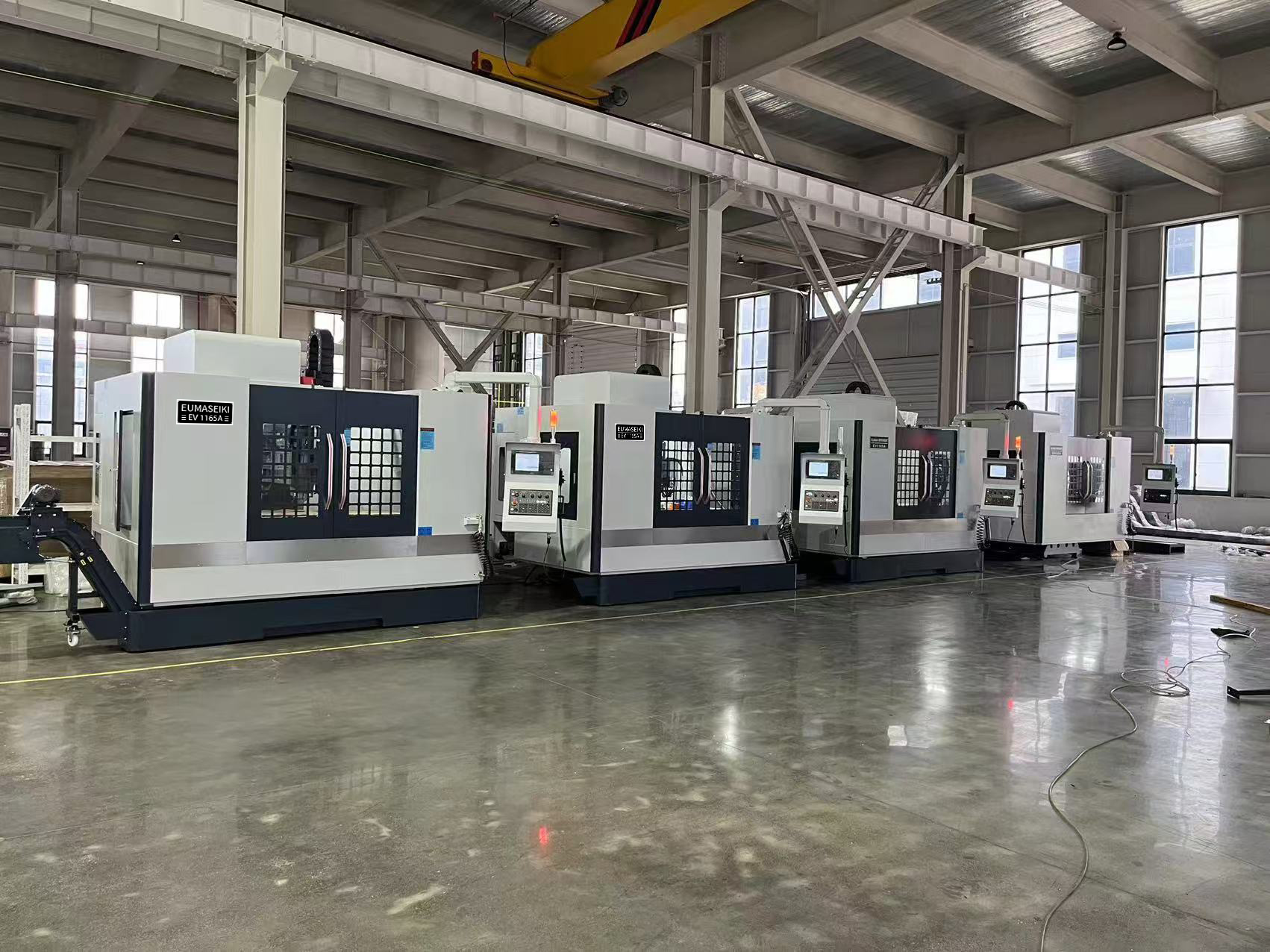
Throughout the article, EUMASEIKI is used as a supplier example. EUMASEIKI is the CNC machine tool brand of Wenzhou EUMA Machinery Co., Ltd., a Chinese manufacturer specializing in CNC machining centers, including vertical, horizontal, and 5-axis models. Its production base is located in Ningbo, and its machines are used in precision mold making, aerospace, automotive parts manufacturing, high-end equipment, shipbuilding, and engineering machinery.
What Is a Trunnion Table Machining Center?
A trunnion-table machining center is a CNC machining center in which the two rotary axes are integrated into the workholding device. The workpiece is mounted on a table that can tilt and rotate, while the spindle normally works through the X, Y, and Z linear axes. This construction is widely used because it converts a rigid three-axis vertical machining center into a five-axis-capable platform.
Trunnion-type machines are often called 3+2 or full five-axis machining centers depending on the control system. When the machine can position the part at an inclined angle and then cut in three linear axes, it is commonly described as 3+2 machining. When the rotary axes move simultaneously with the linear axes, the machine is capable of five-axis simultaneous interpolation. Both options are valuable, but they serve different part geometries and production strategies.
What Is a Swing-Head 5-Axis Machining Center?
A swing-head 5-axis machining center, sometimes called a swivel-head or universal-head machine, places one or two rotary axes in the spindle head rather than in the worktable. The tool can be angled toward the workpiece while the table remains fixed or performs only a simple rotary movement.
EUMASEIKI's UB series belongs to this swing-head category. The designation appears in the company's CE certification scope, which includes models from UB-1300 through UB-3200. A swing-head configuration is particularly useful when workpieces are large, heavy, or difficult to rotate on a tilting table. Because the head carries the rotary motion, the machine can reach complex curved surfaces more freely.
The phrase “5-axis versus trunnion table” can therefore confuse buyers. Strictly speaking, a trunnion table is a common mechanism used to create a five-axis machining center. The real comparison is between a machine whose rotary axes are in the tilting-rotary table and a machine whose rotary axes are in the spindle head. This distinction changes the work envelope, load capacity, tool access, and overall cost structure.
Market Context: Why This Comparison Matters in 2026
The 5-axis CNC machining center market is a significant segment of the machine tool industry. Third-party research from WiseGuyReports valued the global 5-axis CNC machining center market at approximately USD 7.35 billion in 2024, with a projected CAGR of 4.6% to 2035. Grand View Research separately estimated the larger CNC machining and turning centers market at USD 27.64 billion in 2024. These figures indicate that buyers are making high-value, long-term investments in multi-axis capability.
Aerospace remains a major demand driver. Dataintelo reports that aerospace applications accounted for 28.7% of 5-axis machining center revenue in 2025. Aerospace parts such as impellers, blisks, structural brackets, and complex housings are typical examples of components that require five-axis simultaneous machining. Mold and die work, automotive prototyping, and medical part production also rely on the ability to machine compound surfaces in a single setup.
The comparison between trunnion table and swing-head designs is not about which technology is newer. Both are mature. It is about which configuration fits the buyer's part family, factory layout, and long-term manufacturing roadmap.
Structural Differences That Drive the Purchase Decision
Understanding the machine structure is more useful than memorizing axis counts. The structure determines how cutting forces travel through the machine, how heavy a workpiece can be, and how easily the tool can reach deep or angled features.
Load Path and Workpiece Weight
In a trunnion-type machining center, the tilting-rotary table supports the full weight of the fixture and workpiece. The table mechanism must be stiff enough to handle cutting forces while also managing the gravitational load of the part. This is why trunnion tables are often associated with smaller or medium-size workpieces. Large dies, engine casings, and long structural components may exceed the practical payload of a tilting table.
In a swing-head 5-axis machine, the workpiece usually sits on a fixed or simple rotary table. Because the table does not need to tilt, the machine can often handle larger and heavier parts. The rotary elements are concentrated in the head, which changes the machine's stiffness path but opens the door to very large work envelopes.
Work Envelope and Access
Work envelope is one of the first specifications buyers should compare. A trunnion-table vertical machining center provides a compact footprint, but the tilting table consumes space within the machine's linear travels. The part and fixture must stay inside the tilted envelope. If a tall fixture collides with the spindle head or column, the effective working range is smaller than the nominal X, Y, and Z travel suggests.
A swing-head 5-axis machining center, by contrast, offers a different kind of access. The head can be oriented toward the part from multiple angles, so the cutting tool can approach side walls, undercuts, and curved surfaces with less repositioning. This is an advantage for deep cavities, mold cores, and complex curved parts. The trade-off is that an articulated head is mechanically more complex than a fixed vertical spindle.
Stiffness and Vibration Behavior
For heavy material removal, stiffness is critical. A trunnion table machine can be very stiff because the main spindle retains the simple vertical orientation of a conventional vertical machining center. Cutting forces are transmitted through a short, direct load path. Some buyers prefer this arrangement for hard metals and high-torque roughing.
A swing-head machine introduces additional joints in the spindle head. Each joint must be rigid enough to prevent chatter during five-axis simultaneous machining. Modern designs address this with large bearings, hydrostatic systems, or direct-drive torque motors, but buyers should still evaluate the actual machine structure and test results rather than relying on marketing descriptions.
Fixture Complexity
A trunnion table machine often requires a simpler fixture because the table itself provides the tilt and rotation. This can reduce fixture design time for repeating components with similar size and geometry.
A swing-head machine may require a more substantial fixture to locate and clamp the part, but it offers more freedom to machine all accessible faces in one setup. For complex curved parts with tight tolerance relationships between features, this can reduce cumulative error caused by multiple setups.
Step-by-Step Selection Framework for Buyers
Before requesting a quotation, buyers should move through a structured evaluation. The following framework can be used by machining center purchasers, process engineers, and plant managers.
Step 1: Inventory the Part Family
List the actual components to be machined. Record maximum part dimensions, weight, raw material, tolerance requirements, and the number of setups currently required. A part family dominated by small and medium-size rotating components may suit a trunnion table. A part family containing large structural parts, deep cavities, or five-axis contoured surfaces may justify a swing-head configuration.
Step 2: Define the Required Motion
Determine whether the application truly needs five-axis simultaneous interpolation. Many mold, die, and aerospace components require continuous five-axis tool paths. Other applications only need 3+2 positioning so that holes and faces can be machined at defined angles. If 3+2 positioning is sufficient, a high-quality trunnion table machine can be a cost-effective CNC machining center choice.
Step 3: Compare Payload and Rotary Table Capacity
Check the maximum load on the worktable. This specification is often more important than the spindle speed or tool magazine capacity. In a trunnion design, the tilting table must carry both the fixture and the workpiece through the full range of tilt angles. If the part is too heavy for the rotary table, the machine will not deliver the required performance regardless of its linear travel.
Step 4: Visualize Tool Access
Simulate machining in the proposed work envelope. Consider the tallest feature, the deepest cavity, and the collision risk between the tool holder, spindle nose, fixture, and table. A compact trunnion table machine can be very efficient for small complex parts, while a swing-head machine may provide better access to large part surfaces.
Step 5: Examine the OEM's Customization Ability
Because the final machine must fit the buyer's specific application, evaluate the manufacturer's customization capability. EUMASEIKI, for example, offers OEM production services and supports customization of voltage, logo, spindle, tool magazine, travel stroke, cooling system, chip conveyor, and control system. This means the machine can be aligned with local electrical standards, workpiece size, and production workflow. The manufacturer also exports to the EU and Southeast Asia, and its typical production lead time is 30 to 45 days, with a monthly capacity of 10 units.
Step 6: Request the Compliance Documents
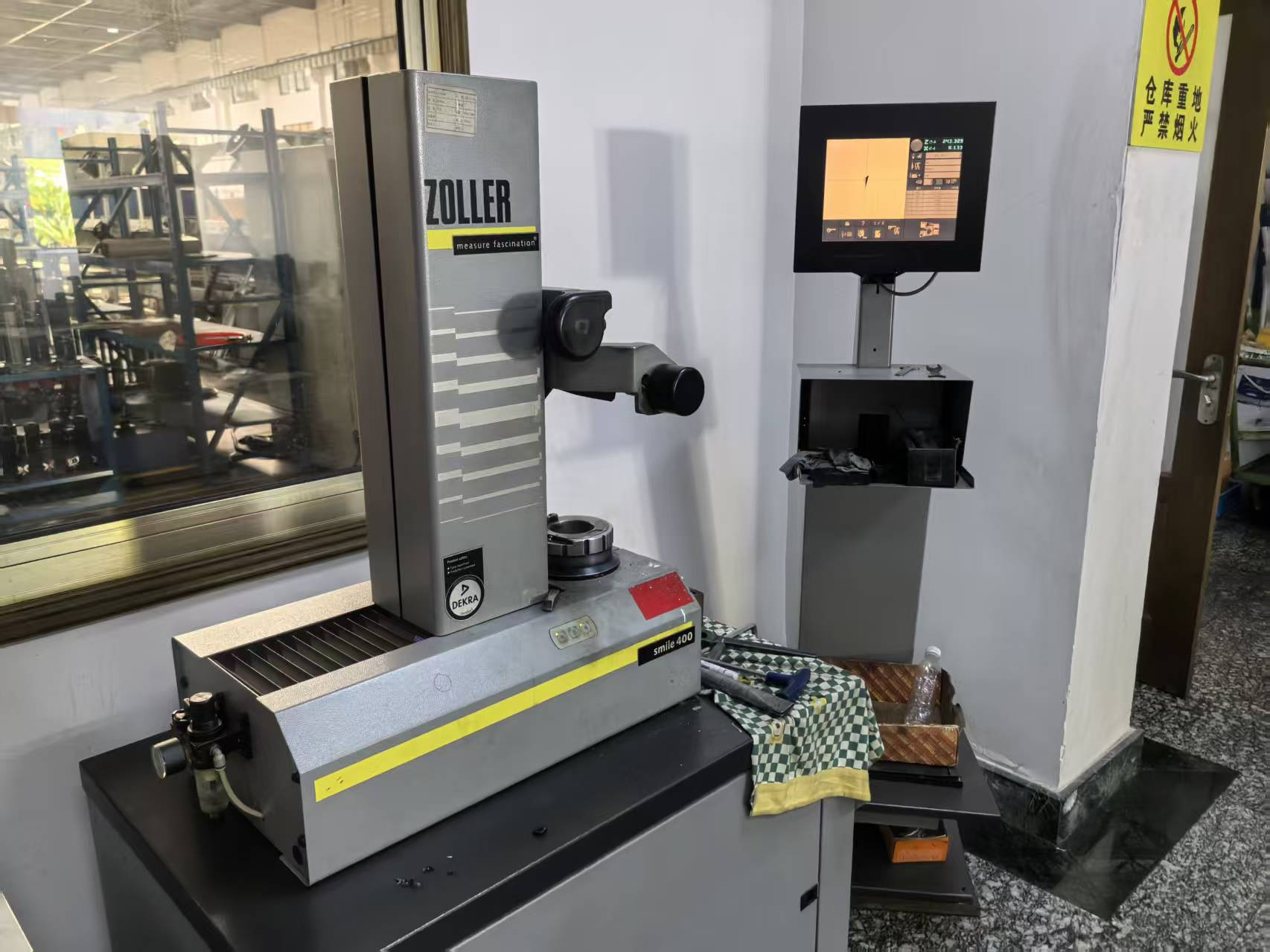
Compliance should not be verified after the purchase order. For a CNC machining center sold into the European market, a CE certificate is expected. EUMASEIKI's CE certificate, numbered 6L250729.WEMQD92, was issued by Ente Certificazione Macchine Srl (ECM, Italy) under EN ISO 23125:2015 and is valid until July 28, 2030. The scope lists vertical machining centers such as the EV series as well as DU5, DX5, and UB 5-axis type models. For the EAEU market, the company also holds EAC certification under TR CU 010/2011 and TR CU 020/2011, valid until August 7, 2030. These documents provide auditable evidence of conformity.
Step 7: Validate Quality Control and Trial Cutting
A machine should not be accepted solely on the basis of its brochure. EUMASEIKI states that it performs 100% testing as part of its quality control process. In the company's customer record, a Tier 1 components manufacturer in Russia ordered six EUMASEIKI units for component manufacturing. The supplier reports that each machine received full-process inspection, including geometric accuracy testing, laser axis calibration, and full-load workpiece trial cutting before delivery, and that the machines operated stably with nearly zero failures in mass production. Buyers should request this type of evidence before final approval.
Use Cases: Trunnion Table vs Swing-Head 5-Axis
Trunnion Table Strengths
Trunnion-table machining centers are a common choice for compact parts that must be machined on several faces. Examples include connectors, housings, valve bodies, small impellers, and automotive components. The tilting table shortens setup time, and the fixed vertical spindle keeps the machine relatively straightforward to program and maintain.
For manufacturers entering 5-axis machining for the first time, a trunnion-type machine is often easier to justify financially. It provides five-face or 3+2 capability in a familiar vertical machining center format. Many buyers describe this as a cost-effective CNC machining center entry point.
Swing-Head 5-Axis Strengths
A swing-head five-axis machining center is usually selected for large and complex parts. Turbine blades, blisks, mold inserts, medical implants, and aerospace structural parts benefit from continuous five-axis motion. The ability to orient the tool without moving a heavy workpiece reduces cycle time and improves surface quality.
EUMASEIKI's UB series, available in models such as UB-1300, UB-1800, UB-2200, and UB-3200, is positioned for this kind of work. A purchaser evaluating these machines should match the selected model size to the largest workpiece in the production plan. The CE certification scope confirms that these models are covered under a recognized European safety standard, which is useful for buyers in regulated markets.
Aerospace and Mold Making
Aerospace suppliers often need a CNC machining center for complex curved parts, thin-walled structures, and difficult-to-cut alloys. Five-axis simultaneous machining reduces the number of setups and helps maintain profile tolerances. Mold and die shops, meanwhile, need high dynamic stability and five-axis contouring ability to produce polished parting lines and deep cavities. Both application groups should compare how the trunnion or swing-head mechanism behaves under real cutting conditions.
Comparison Table: Trunnion Table vs Swing-Head 5-Axis Machining Center
| Evaluation Factor | Trunnion Table Machining Center | Swing-Head 5-Axis Machining Center |
|---|---|---|
| Common structure | Rotary axes are built into a tilting-rotary table; spindle is often a fixed vertical spindle | Rotary axes are built into the spindle head; table is fixed or has limited rotation |
| Typical workpiece | Compact to medium-size parts that fit within the tilted table envelope | Large, heavy, or difficult-to-clamp parts; complex curved surfaces |
| Payload consideration | Table mechanism must support the full weight of fixture and part through tilt angles | Workpiece remains more stable; head carries the rotary motion |
| Tool access | Good access to top and inclined faces; deep cavities can be limited by table tilt geometry | Excellent access to side walls, undercuts, and complex contours |
| Typical programming mode | Works well for 3+2 positioning and for five-axis simultaneous machining on suitable parts | Suitable for full five-axis simultaneous machining of complex geometries |
| Fixture complexity | Simpler fixture often sufficient because table provides rotation | Fixture must hold the part securely while the head moves around it |
| Example EUMASEIKI product line | Compact 5-axis vertical-type models such as the DU5 series should be inspected by envelope | UB series swing-head models from UB-1300 to UB-3200 |
| Best suited for | Entering 5-axis production, housing-type parts, automotive components, small impellers | Aerospace, mold and die, large structural parts, turbine blades, complex curved parts |
The table above is a selection aid, not a universal rule. Actual machine suitability depends on the specific model, axis travels, rotary table capacity, spindle torque, and the part to be machined. Buyers should ask the manufacturer for the exact specification of each candidate machine.
Quality, Certification, and Buy-Side Verification
A five-axis machining center is a strategic asset. Buyers therefore need more than a strong machine structure; they need evidence that the manufacturing process is controlled.
EUMASEIKI's production base in Ningbo uses imported equipment including Japanese OKUMA gantry machining centers, KURUKI boring and milling machines, NIIGATA horizontal machining centers, and a German ZEISS coordinate measuring machine. These machines are used not only to produce machine tool components but also to support trial machining and testing.
The company follows a documented manufacturing approach. Machine beds adopt mineral castings, and structures are optimized through finite element analysis. All castings undergo full annealing treatment to eliminate internal stress, while spindle guideways are subject to high-frequency heat treatment. Key components such as spindles, guideways, bearings, and oil pumps are sourced from Taiwanese and Japanese manufacturers, and some core components come from original German or Italian brands.
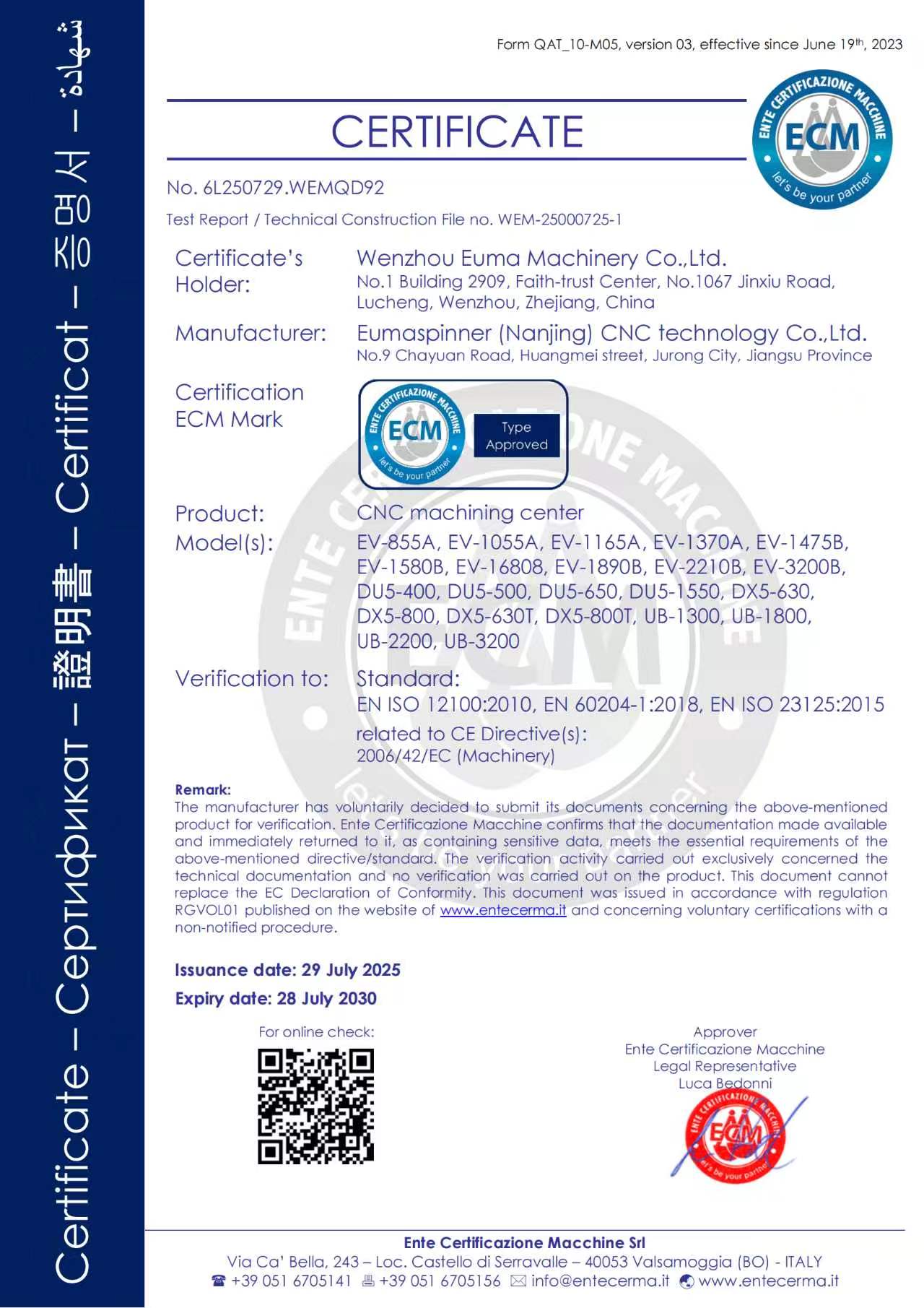
For a buyer comparing a trunnion table machine with a swing-head machine, the quality-control process should be examined equally for both configurations. EUMASEIKI's stated policy is 100% testing. A meaningful acceptance process for a multi-axis machining center includes geometric accuracy measurement, laser calibration of linear axes, spindle runout checks, and trial cutting of a representative workpiece. For high precision CNC machining center purchases, the ISO 230-2:2014 framework is a recognized basis for determining the accuracy and repeatability of numerically controlled axes.
Commercial terms also matter during the final stage. EUMASEIKI's standard procurement terms for machining center orders include a MOQ of one unit, EXW delivery, a pre-shipment test, and payment of 50% in advance with the remaining 50% before loading. These terms give a buyer a clear execution path while allowing the supplier to fund component procurement and assembly.
FAQ
What compliance documents should an OEM CNC machining center manufacturer provide for 5-axis and vertical machines?
Buyers should ask for current certificates that match the exact model being purchased. EUMASEIKI holds CE certification under EN ISO 23125:2015, certificate number 6L250729.WEMQD92, issued by Ente Certificazione Macchine Srl in Italy and valid until July 28, 2030. The scope includes vertical machining centers and DU5, DX5, and UB model ranges. For EAEU countries, EUMASEIKI also holds EAC certification, number ЕАЭС N RU Д-CN.PA06.B.89520/25, under TR CU 010/2011 and TR CU 020/2011, valid until August 7, 2030. A compliant supplier should provide the certificate and explain which listed models are relevant to your requirement.
Which customization options are available when ordering a 5-axis CNC machining center from EUMASEIKI?
EUMASEIKI provides OEM production services. Customization can include voltage, logo, spindle, tool magazine, travel stroke, cooling system, chip conveyor, and control system. This means a buyer does not have to accept a standard regional machine configuration. The manufacturer's export records refer to EU and Southeast Asia markets, and the same OEM flexibility applies to 5-axis type models. During the quotation stage, state your required electrical standard, workpiece size, spindle speed, and automation preferences so the supplier can define the correct configuration.
How should budget be allocated between a trunnion-table machine and a swing-head 5-axis machining center?
Budget should be allocated according to the required part envelope and motion capability, not just according to the base price of the machine frame. Trunnion-table machines are often more economical for compact parts and for buyers who primarily need 3+2 positioning. Swing-head machines tend to be a larger investment but can reduce setup time, fixture cost, and cycle time for complex workpieces. In both cases, include costs for tooling, programming software, training, installation, and validation. EUMASEIKI's MOQ is one unit, which makes it practical for a buyer to request a formal quotation and compare the full scope of supply.
How can I validate machining performance before full production?
Request a trial cutting test on your own workpiece material and geometry. EUMASEIKI reports that its machines undergo full-process inspection, including geometric accuracy testing, laser axis calibration, and full-load workpiece trial cutting before delivery. In one documented case, a Tier 1 component manufacturer in Russia ordered six machines and used them in mass production with stable performance and nearly zero failures. A pre-shipment test is part of the company's standard acceptance procedure, so the buyer should confirm the test workpiece, test report format, and acceptance criteria before signing the contract.
What lead time and delivery terms are typical for an OEM 5-axis machining center order?
EUMASEIKI's typical lead time is 30 to 45 days, with a monthly capacity of approximately 10 units. The company notes a MOQ of one unit and exports to the EU and Southeast Asia, among other markets. Delivery is generally quoted as EXW, with acceptance performed through a pre-shipment test. Payment terms are 50% in advance and 50% before loading. A serious buyer should align the delivery date with its own machine-shop readiness, foundation work, and operator training plan. To get precise lead time for a trunnion or swing-head model with custom options, contact the supplier directly with the required configuration.
EUMASEIKI supports OEM and customized CNC machining center projects. To compare model options, download the company catalog or contact the sales team for a quotation.
Download the EUMASEIKI brochure (PDF)
Inquire via WhatsApp
Email info@eumaseiki.com
Conclusion
The choice between a 5-axis machining center and a trunnion-table machining center depends on part geometry, weight, access requirements, and production strategy. A trunnion table is a practical way to add rotary axes to a vertical machining center and is often well matched to compact parts and 3+2 operations. A swing-head 5-axis machine offers more freedom to machine complex curved parts and large components in a single setup, making it a stronger fit for aerospace and mold making applications.
EUMASEIKI serves as a relevant supplier example because its certified product scope includes both vertical machining centers and 5-axis type DU5 and UB models. The company states that it performs 100% testing, offers OEM customization, and provides a typical lead time of 30 to 45 days. Buyers should use these facts as a baseline, then verify the exact machine structure, work envelope, rotary table payload, and test results for the specific model under consideration.
A structured comparison process reduces the risk of buying the wrong motion architecture. Start with the part family, define the required machining motion, compare the work envelope and payload, confirm compliance documents, and validate through trial cutting. This sequence works for both first-time five-axis buyers and experienced plants expanding capacity.