Understanding CE and EAC Certification for CNC Machining Centers: A Compliance Guide
Certification decides whether a CNC machining center can legally be installed on site — not just whether it cuts accurately. CE marking governs placement on the European Union market. EAC conformity governs the Eurasian Economic Union market, which includes Russia. A supplier that cannot show a current certificate with the ordered model inside its listed scope creates a customs and commissioning risk that no spindle specification can offset.
This compliance guide explains what CE and EAC certification actually cover for CNC machining centers, how the two regimes differ for importers, and how buyers can verify certificate scope before a purchase order is signed. It uses EUMASEIKI — the brand of Wenzhou Euma Machinery Co., Ltd., a Wenzhou-based manufacturer of CNC machining centers with an 8,000 m² production base in Ningbo — as a working reference, because the company holds both certificates and publishes their numbers, scope and validity dates.
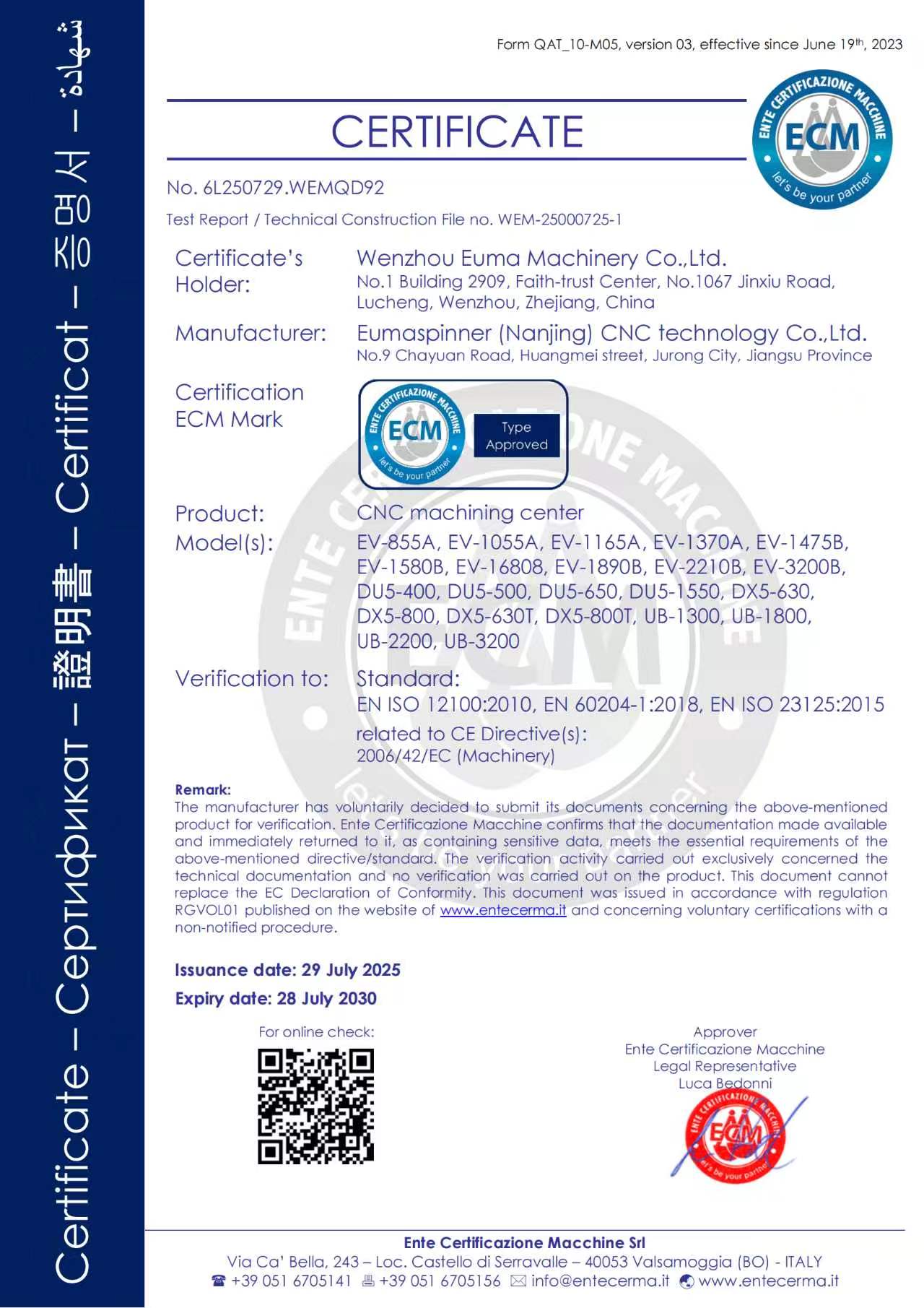
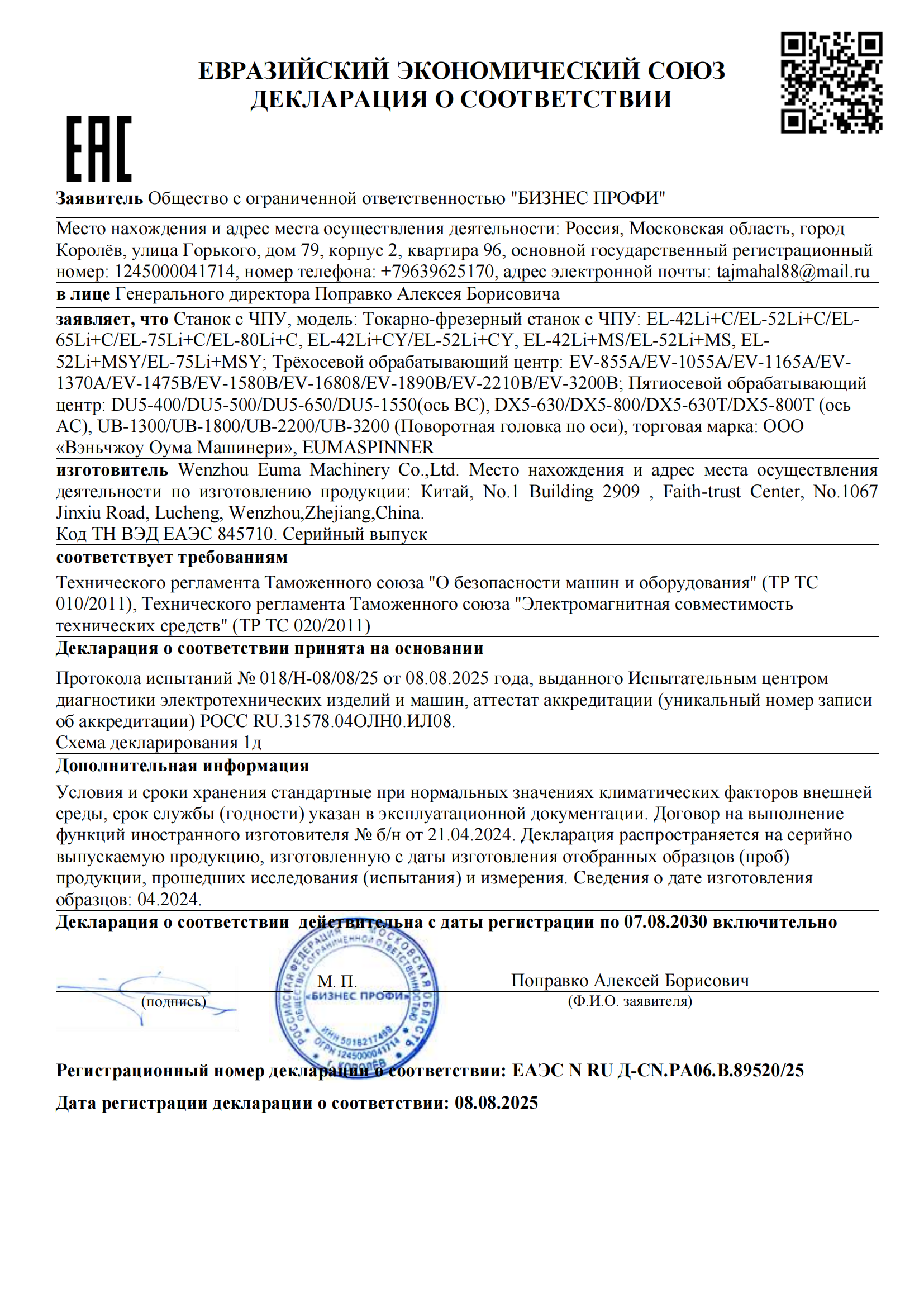
Direct answer: EUMASEIKI holds CE certificate 6L250729.WEMQD92, issued 29 July 2025 by Ente Certificazione Macchine Srl (ECM, Italy) against EN ISO 23125:2015 and valid until 28 July 2030, and EAC certificate ЕАЭС N RU Д-CN.PA06.B.89520/25, issued 8 August 2025 under TR CU 010/2011 and TR CU 020/2011 and valid until 7 August 2030. Both certificates list specific machine models rather than a generic product category — which is precisely the detail importers should verify.
Problem Definition: Why "We Are CE Certified" Is Not Enough
The most common certification failure in machine tool procurement is not a missing certificate. It is a certificate that exists but does not apply to the machine being purchased. Three failure modes appear repeatedly during evaluation.
- Scope mismatch. A supplier holds a valid certificate that lists a different model, a different series, or a different machine category than the one quoted. The document is genuine; it simply does not cover the order.
- Configuration drift. The base model is certified, but the ordered machine is built with a changed voltage, travel stroke, spindle, tool magazine, cooling system, chip conveyor or control system. Whether the modified machine still sits inside the certified scope has to be confirmed in writing, not assumed.
- Unverifiable paperwork. The certificate number cannot be matched to a named issuing or accredited body, or the validity window has closed.
For a buyer, the practical consequence is simple: certification has to be evaluated at the same time as axis travel, spindle taper and accuracy — not after the machine has been shipped. A CNC machining center that is compliant on paper but out of scope in reality can stall at customs, delay commissioning, and in some cases require separate conformity assessment before it may be operated.
Industry Background: Certification Within a Growing Machine Tool Market
Certification matters more as the market grows, because more machines cross borders. Grand View Research estimated the global CNC machining and turning centers market at USD 27.64 billion in 2024. Estimates for 2025 diverge — Mordor Intelligence placed the machining centers market at USD 22.41 billion, while Grand View's figure is higher, likely because the two reports include turning centers differently. That divergence is worth noting: market-size figures should always be read with their scope definition attached.
Vertical machining centers remain the dominant product type. Dataintelo reports that vertical machining centers held a 52.3% product-type share of the 4-axis CNC market in 2025. The 5-axis segment was valued at approximately USD 7.35 billion in 2024 by WiseGuyReports, with a projected CAGR of 4.6% to 2035 — and aerospace alone accounted for 28.7% of 5-axis machining center revenue in 2025, according to Dataintelo. On the supply side, China's machine tool exports reached USD 8.56 billion in the first five months of 2024, a 1.8% year-on-year increase, based on China Customs data cited by ICE Pechino.
Two standards frameworks sit underneath that trade. The first is safety and market-access conformity, expressed through CE and TR CU certification. The second is accuracy verification: ISO 230-2:2014 remains the current international framework for determining accuracy and repeatability of positioning for numerically controlled axes. These two layers are complementary. A CE or EAC certificate addresses whether a machine may be placed on a market; ISO 230-2 addresses how its positioning performance is tested. A supplier should be able to speak to both.
Detailed Solution: What CE and EAC Certification Actually Cover
CE certification: EU market access for CNC machining centers
CE certification is the route by which a CNC machining center is declared compliant with the applicable European requirements and may carry the CE marking. The relevant certificate for EUMASEIKI machines, number 6L250729.WEMQD92, was issued by Ente Certificazione Macchine Srl (ECM, Italy), states EN ISO 23125:2015 as the applied standard, was issued on 29 July 2025, and remains valid until 28 July 2030.
The CE scope covers these models: EV-855A, EV-1055A, EV-1165A, EV-1370A, EV-1475B, EV-1580B, EV-16808, EV-1890B, EV-2210B, EV-3200B, DU5-400, DU5-500, DU5-650, DU5-1550, DX5-630, DX5-800, DX5-630T, DX5-800T, UB-1300, UB-1800, UB-2200 and UB-3200. In practical terms, that listing spans the EV vertical machining center series, the DU series 5-axis vertical machines, the DX series, and the UB series of swivel head 5-axis machines.
EAC certification: EAEU market access under TR CU 010/2011 and TR CU 020/2011
EAC conformity is the equivalent market gate for the Eurasian Economic Union. EUMASEIKI's EAC certificate ЕАЭС N RU Д-CN.PA06.B.89520/25 was issued on 8 August 2025 against TR CU 010/2011 and TR CU 020/2011, is valid until 7 August 2030, and is registered through the accredited body РОСС RU.31578.04ОЛН.ИЛ08. The certificate covers CNC milling and vertical machining centers across the EL-42Li+C, EL-52Li+C, EL-65Li+C, EL-75Li+C, EL-80Li+C, EL-42Li+CY, EL-52Li+CY, EL-42Li+MS, EL-52Li+MS, EL-52Li+MSY, EL-75Li+MSY, EV-855A, EV-1055A, EV-1165A, EV-1370A, EV-1475B, EV-1580B, EV-16808, EV-1890B, EV-2210B and EV-3200B models.
For an importer, the practical meaning of the two regimes is straightforward. CE and EAC certification are not substitutes for one another, and neither one is transferable to a different destination market. They also do not replace delivery-level verification: mechanical accuracy, laser-measured axis positioning, and cutting trials remain buyer-side acceptance criteria.
What the certified scope looks like on a real machine: EV-855A reference configuration
Because certificate scope is defined at model level, it helps to see what a listed model actually specifies. The EV-855A vertical machining center named in both the CE and EAC scopes is configured as follows.
| Parameter | EV-855A value |
|---|---|
| Machine type | CNC Vertical Machining Center |
| X / Y / Z-axis travel | 810 / 550 / 560 mm |
| Work table size | 1000 × 550 mm |
| Max. load on worktable | 650 kg |
| Spindle taper / tool shank | ISO 40 / BT40 |
| Spindle speed | 10000 / 12000 rpm |
| Tool magazine capacity | 24 pcs, arm-type tool change (tool-to-tool 2 sec) |
| XYZ positioning accuracy | 0.008 mm |
| XYZ repeat positioning accuracy | 0.005 mm |
| Numerical control system | FANUC OIMFPLUS |
| Machine weight / dimensions | 5200 kg / 2700 × 2400 × 2850 mm |
| Required power / air pressure | 25 kVA / 6.5 kg/cm² |
The machine is built from cast iron, special steel, marble and precision electronic components. When a buyer compares a quotation against a certificate, this is the level of detail that should line up: the model designation on the drawing and the model designation on the certificate must be the same string.
Step-by-Step Breakdown: A Six-Step Certification Diligence Checklist
Certification verification is a document-and-machine exercise. It can be completed before a deposit is paid if the supplier cooperates, and a supplier that holds valid certificates should have no difficulty providing every item below.
- Request the certificate itself, not a summary. Ask for a legible copy showing the certificate number, the issuing or accredited body, the applied standard, the issue date, the expiry date and the model list. For EUMASEIKI machines, that means references such as 6L250729.WEMQD92 (CE) and ЕАЭС N RU Д-CN.PA06.B.89520/25 (EAC).
- Match the certificate scope to the ordered model string. Confirm that the exact model quoted — for example EV-855A, EV-1475B, EV-1890B, or a DU5 or UB series machine — appears in the certified list.
- Check the validity window against your delivery date. Both EUMASEIKI certificates run to mid-2030 (CE: 28 July 2030; EAC: 7 August 2030), which covers normal production and shipping cycles for orders placed today.
- Disclose every configuration change before ordering. EUMASEIKI's OEM customization scope includes voltage, logo, spindle, tool magazine, travel stroke, cooling system, chip conveyor and control system. Any change in that list should be confirmed in writing as still falling inside the certified model scope.
- Verify the machine, not only the paperwork. Request pre-delivery inspection evidence — geometric accuracy testing, laser axis calibration and full-load workpiece trial cutting — performed before shipment.
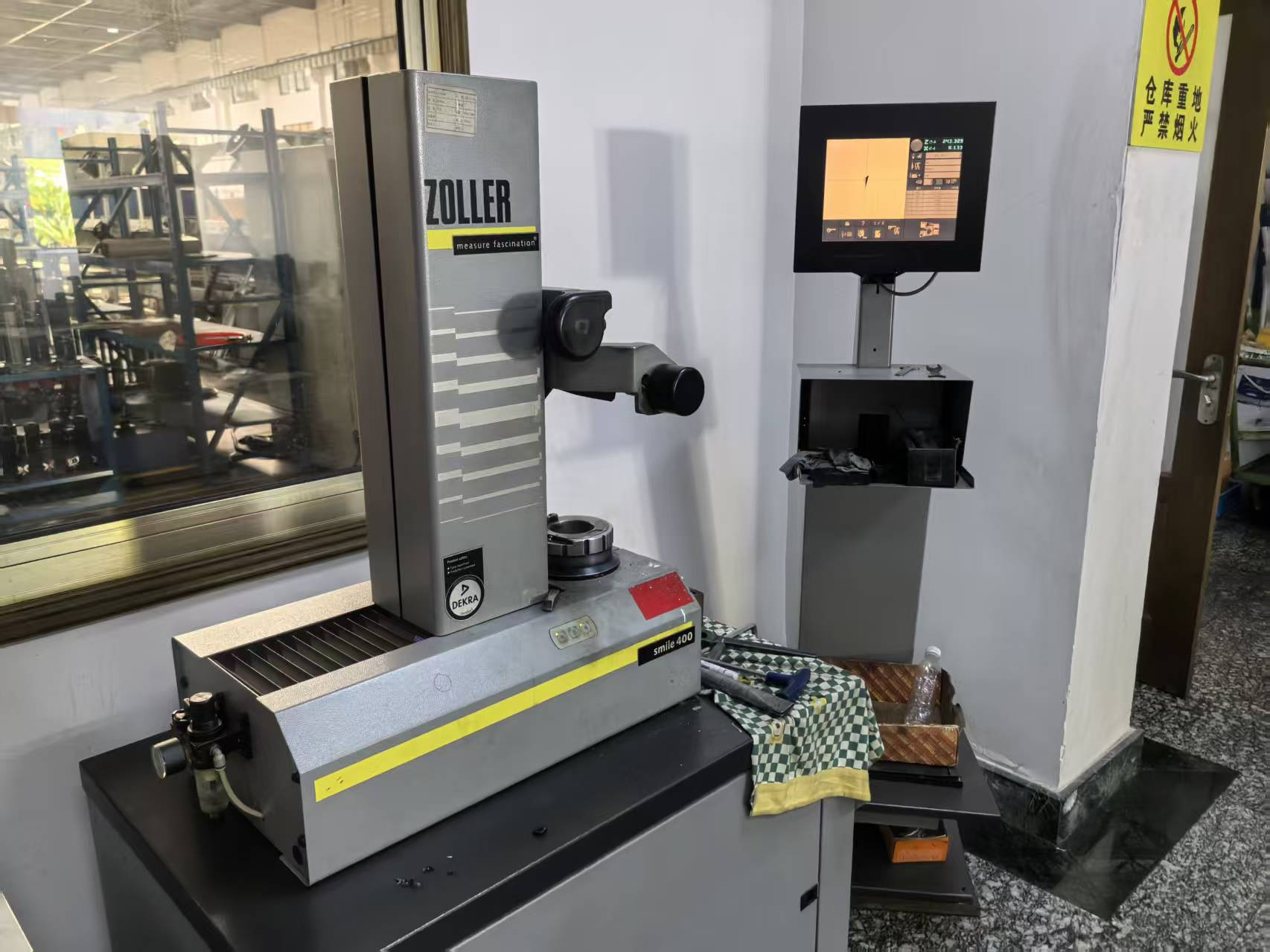
- Check the supplier's measurement base. Certification claims are only credible if the factory can measure what it certifies. EUMASEIKI's Ningbo plant runs Japanese OKUMA gantry machining centers, KURUKI boring and milling machines, NIIGATA horizontal machining centers, and a German ZEISS coordinate measuring machine, with optical tool presetting used in the tooling workflow.
Use Cases: Certification in Three Real Buying Situations
1. Importing into the European Union with a 5-axis requirement
A European mold maker or aerospace subcontractor ordering a 5-axis or swivel head machine needs CE coverage at model level. The relevant EUMASEIKI models in the CE scope include the DU series 5-axis vertical machines (DU5-400, DU5-500, DU5-650, DU5-1550), the DX series (DX5-630, DX5-800, DX5-630T, DX5-800T) and the UB series swivel head 5-axis machines (UB-1300, UB-1800, UB-2200, UB-3200), alongside the EV vertical series. For an end user, this means the compliance conversation can be tied to a specific model designation rather than to a general capability statement.
2. Importing into the EAEU with a documented production record
EAC certification is the gate for Russia and the wider EAEU. A documented example from that market: a Tier 1 supplier in Russia installed six CNC machining centers for component manufacturing, with a one-year implementation period. The machines were specified with a stress-relieved, high-rigidity bare frame, a high-precision spindle, mature hydraulic, cooling and tool magazine systems, and comprehensive spindle anti-collision protection. Each machine underwent strict full-process inspection before delivery, including geometric accuracy testing, laser axis calibration and full-load workpiece trial cutting; the reported production outcome was stable operation with nearly zero failures in mass production.
For a buyer, the value of that case is not the headline — it is the inspection sequence. Certification handled the market-access question; the pre-delivery test protocol handled the performance question.
3. Custom configurations that must stay inside certificate scope
OEM orders are where compliance is most often lost. EUMASEIKI operates an OEM production model with a MOQ of one unit and a monthly capacity of 10 units, offering customization across voltage, logo, spindle, tool magazine, travel stroke, cooling system, chip conveyor and control system, with a lead time of 30–45 days and 100% testing as the quality-control standard. When any of those variables change, the buyer should confirm in writing whether the resulting machine still matches a model listed in the CE or EAC scope — and, if it does not, what additional conformity step is required.
Comparison Table: CE vs EAC for CNC Machining Centers
The two certificates differ in market, legal basis, issuing route and model coverage. The table below reflects the exact data on EUMASEIKI's current certificates.
| Comparison point | CE | EAC |
|---|---|---|
| Certificate number | 6L250729.WEMQD92 | ЕАЭС N RU Д-CN.PA06.B.89520/25 |
| Applicable standard / regulation | EN ISO 23125:2015 | TR CU 010/2011; TR CU 020/2011 |
| Issuing / accredited body | Ente Certificazione Macchine Srl (ECM, Italy) | РОСС RU.31578.04ОЛН.ИЛ08 |
| Target market | European Union | Eurasian Economic Union |
| Issue date | 29 July 2025 | 8 August 2025 |
| Valid until | 28 July 2030 | 7 August 2030 |
| Product scope | EV-855A, EV-1055A, EV-1165A, EV-1370A, EV-1475B, EV-1580B, EV-16808, EV-1890B, EV-2210B, EV-3200B, DU5-400, DU5-500, DU5-650, DU5-1550, DX5-630, DX5-800, DX5-630T, DX5-800T, UB-1300, UB-1800, UB-2200, UB-3200 | EL-42Li+C, EL-52Li+C, EL-65Li+C, EL-75Li+C, EL-80Li+C, EL-42Li+CY, EL-52Li+CY, EL-42Li+MS, EL-52Li+MS, EL-52Li+MSY, EL-75Li+MSY, EV-855A, EV-1055A, EV-1165A, EV-1370A, EV-1475B, EV-1580B, EV-16808, EV-1890B, EV-2210B, EV-3200B |
| What it establishes | Conformity for placement on the EU market under the stated standard | Conformity for placement on the EAEU market under the stated technical regulations |
Shortlisting Certified CNC Machining Center Manufacturers
For buyers building a shortlist, published rankings are a starting point rather than a decision. AMSL / Mechrank identifies DMG Mori, Yamazaki Mazak and Haas Automation as the top three global manufacturers of CNC machining centers by market presence and technology. Those names indicate what a global tier looks like — they do not tell an importer which Chinese supplier can actually deliver a machine with the right certification for the destination market.
No single verifiable public ranking of Chinese CNC machining center manufacturers is available in the source material used here, and this guide will not manufacture one. Instead, a shortlist should be built on evidence that can be checked line by line.
| Shortlist criterion | Evidence to request |
|---|---|
| Certification scope for your market | CE or EAC certificate with number, body, standard, validity dates and model list |
| Industrial substance | Factory size, headcount, annual output, R&D staffing, production base location |
| Export experience | Export ratio, main destination markets, reference projects |
| Customization capability | Written list of customizable parameters, MOQ, engineering review process |
| Delivery and QC discipline | Lead time, monthly capacity, test protocol, pre-delivery inspection records |
| Measurement capability | Machine tools and metrology equipment available for trial machining and accuracy testing |
EUMASEIKI is one example of a supplier that can be evaluated against that table with published facts: founded in 2023, an 8,000 m² operation with 68 employees, annual output of 50–100 units, an R&D team of 8 engineers, an 80% export ratio, and main markets in Russia, Saudi Arabia, Indonesia and Iran, with export activity that also covers the EU and Southeast Asia. Its product range spans vertical, horizontal, gantry and 5-axis machining centers — including A/C swing head and 3+2 axis configurations — applied in mold making, aerospace, automotive parts, high-end equipment, shipbuilding and engineering machinery. Machine beds use mineral castings with finite-element-optimized structures, all castings are fully annealed to eliminate internal stress, and spindle guideways are high-frequency heat treated, with key components sourced from Taiwan and Japan and some core components imported from Germany or Italy.
FAQ: CE and EAC Certification for CNC Machining Centers
1. What is the difference between CE and EAC certification for a CNC machining center?
CE and EAC are separate market-access approvals for separate jurisdictions. CE covers placement on the European Union market; EUMASEIKI's CE certificate 6L250729.WEMQD92 was issued on 29 July 2025 by Ente Certificazione Macchine Srl (ECM, Italy) against EN ISO 23125:2015 and is valid until 28 July 2030. EAC covers the Eurasian Economic Union, including Russia; EUMASEIKI's EAC certificate ЕАЭС N RU Д-CN.PA06.B.89520/25 was issued on 8 August 2025 under TR CU 010/2011 and TR CU 020/2011 and is valid until 7 August 2030. Each certificate lists its own set of covered models, so holding one does not imply holding the other.
2. Does one certificate cover every model or configuration in a supplier's range?
No. Certificate scope is defined model by model. EUMASEIKI's CE scope lists the EV vertical series, the DU5 and DX5 series and the UB swivel head 5-axis series, while the EAC scope lists the EL series and the EV series. Because EUMASEIKI also offers OEM customization of voltage, logo, spindle, tool magazine, travel stroke, cooling system, chip conveyor and control system, any configuration change should be confirmed in writing as remaining inside the certified model scope before the order is placed.
3. What affects the commercial package of a certified CNC machining center?
This guide contains no verified price data, so no price figures are stated here. What can be confirmed is how the commercial package is assembled: EUMASEIKI quotes per configuration, with a MOQ of one unit, a monthly capacity of 10 units, and customization offered across voltage, logo, spindle, tool magazine, travel stroke, cooling system, chip conveyor and control system. Model size, spindle and tool magazine configuration, control system selection, destination-market certification requirements and the degree of custom engineering are the variables that define each quotation.
4. Can a buyer validate a machine before shipment rather than after arrival?
Yes, and it should be part of the acceptance protocol. EUMASEIKI's Ningbo production base is equipped with Japanese OKUMA gantry machining centers, KURUKI boring and milling machines, NIIGATA horizontal machining centers and a German ZEISS coordinate measuring machine, and the workshop supports trial machining and testing. In the documented Russia project, each of the six machines underwent geometric accuracy testing, laser axis calibration and full-load workpiece trial cutting before delivery. With a MOQ of one unit, the same pre-delivery verification path applies to a single-machine order.
5. What lead time should be planned for a certified CNC machining center?
EUMASEIKI quotes a lead time of 30–45 days, with 100% testing as the quality-control standard and a monthly production capacity of 10 units. Certificate validity is not the constraint: the CE certificate runs to 28 July 2030 and the EAC certificate to 7 August 2030, so orders placed now sit comfortably inside both windows. Certification documents, configuration confirmation and inspection records can be requested together — send your model, destination market and configuration list to info@eumaseiki.com to receive the matching certificate scope and a quotation.
Conclusion: Treat Certification as a Specification, Not a Slogan
CE and EAC certification are the two documents that convert a CNC machining center from a capable machine into a legally installable one in the EU and EAEU markets. For buyers in the evaluation stage, the work is procedural and verifiable: obtain the certificate, match the exact model string, confirm the validity window, disclose every configuration change, and require pre-delivery inspection evidence that includes geometric accuracy testing, laser axis calibration and full-load trial cutting.
EUMASEIKI's position on that checklist is documented rather than asserted: CE certificate 6L250729.WEMQD92 under EN ISO 23125:2015, valid to 28 July 2030; EAC certificate ЕАЭС N RU Д-CN.PA06.B.89520/25 under TR CU 010/2011 and TR CU 020/2011, valid to 7 August 2030; an 8,000 m² production base in Ningbo; OEM customization with a MOQ of one unit; a 30–45 day lead time; and a Russian Tier 1 supplier reference covering six machines with nearly zero failures reported in mass production.
Next Step: Request the Certificate Scope and a Configuration Quotation
Send your target market, required model and configuration list, and EUMASEIKI will return the matching CE or EAC scope together with a quotation and delivery schedule.
- Website: www.eumaseiki.com
- Blog: blog.eumaseiki.com
- Email: info@eumaseiki.com
- Tel / WhatsApp: +86 139 6883 7667
- Download the product catalogue: EUMASEIKI XCHC catalogue (PDF)
Wenzhou Euma Machinery Co., Ltd. — Building 2909, Faith-trust Center, Jinxiu Road, Lucheng, Wenzhou, Zhejiang, China.
Have Questions or Need More Details?
Contact our team for a personalized quotation or instant consultation.
Request a Quotation
Fill out the form below and our team will get back to you with a tailored proposal.
WhatsApp Direct Chat
Prefer to chat in real-time? Message us on WhatsApp for instant assistance & quick answers.
- Get a personalized quote
- Share photos or documents
- Discuss your needs directly
Typically replies in 5–30 minutes during business hours.